
How Safari Doodles Raises and Socializes Puppies
How Safari Doodles Raises and Socializes Puppies
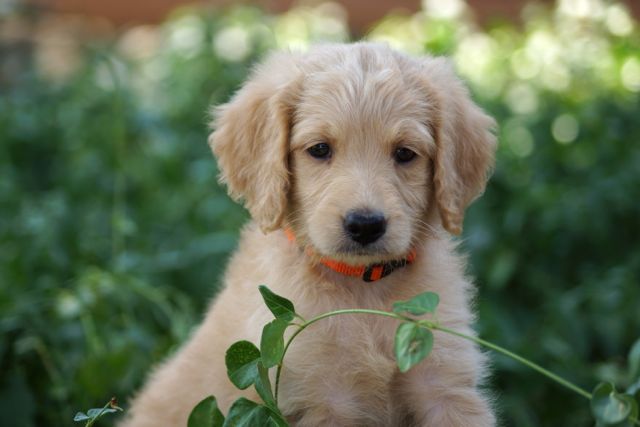
Safari Doodles puppies are born and raised inside our home. From their earliest days, we spend time handling, observing, and getting to know each individual puppy.
Research supports the value of positive early handling and neurological stimulation during puppy development. Studies have found associations with calmer behavior, increased exploration, and, in working dogs, a greater likelihood of progressing to advanced training. ENS is one part of Safari Doodles’ broader early handling and socialization program.
As the puppies grow, they are gradually introduced to new people, sounds, surfaces, indoor and outdoor environments, other dogs, toys, and age appropriate experiences.
At about seven weeks of age, we also use the Volhard Puppy Aptitude Test as one tool to evaluate temperament traits. Test results are considered together with what we have observed while raising each puppy from birth.
Early Socialization and Imprinting
Beginning at about three weeks of age, Safari Doodles puppies are gradually introduced to a wide variety of everyday sounds, voices, surfaces, people, toys, and experiences. We expose puppies to different volumes and types of household noise while making sure the experiences remain appropriate for their age.
Puppies are regularly handled by adults and children and begin learning that people are safe, rewarding, and fun to interact with.
We also begin teaching recall very early. When puppies approach us for food, attention, or play, we use the word “come.”This helps them begin associating the word with moving toward a person and receiving something positive.
As the puppies grow, they spend supervised time outdoors exploring grass, different surfaces, and new surroundings. These experiences help develop coordination, confidence, curiosity, and comfort with the world around them.
Our goal is not simply to expose puppies to as many things as possible. We want each experience to be positive, age appropriate, and confidence building.
Imprinting Safari Doodle Puppies
Around three weeks of age, Safari Doodles puppies begin experiencing a wider variety of sounds, people, and everyday activity. We introduce different types and volumes of music, household noises, alarms, voices, and other age appropriate sounds. Puppies are also regularly handled by men, women, and children.
We begin teaching the meaning of “come” at this age as well. When puppies are fed, when they run toward us for attention, and when we encourage them to follow us during play, we consistently use the word “come.” This helps puppies begin forming a positive association with recall from a very young age.
Starting at about six weeks of age, puppies begin supervised outdoor walks with their mother and littermates in our large fenced yard. They explore grass, new surfaces, sights, sounds, and movement while learning to follow people and stay engaged with us.
These experiences help build coordination, confidence, curiosity, and comfort in new environments while giving puppies a strong foundation for future training.
Training Our Doodle Puppies
Safari Doodles puppies are carefully introduced to a variety of adult dogs, people, sounds, surfaces, and everyday environments. We are selective about where our puppies are exposed and only use animals and areas we know to be safe and free from known disease risks.
Our puppies learn to climb stairs, use a doggy door, and become comfortable moving between indoor and outdoor spaces. Early training begins at about six weeks of age. Puppies begin learning to come when called and to potty outside on both gravel and grass. When they are in their play pen, they are also trained to use a designated potty box.
Puppies are encouraged to play with balls and tug toys and begin learning appropriate mouth behavior and gentle play. We educate the puppies to mouth and bite toys and not people. We believe that education of manners must be started early.
Our goal is to give each puppy a strong foundation before going home so the transition into a new family is easier for both the puppy and the family.
Playpens with a Potty Pan for young puppies
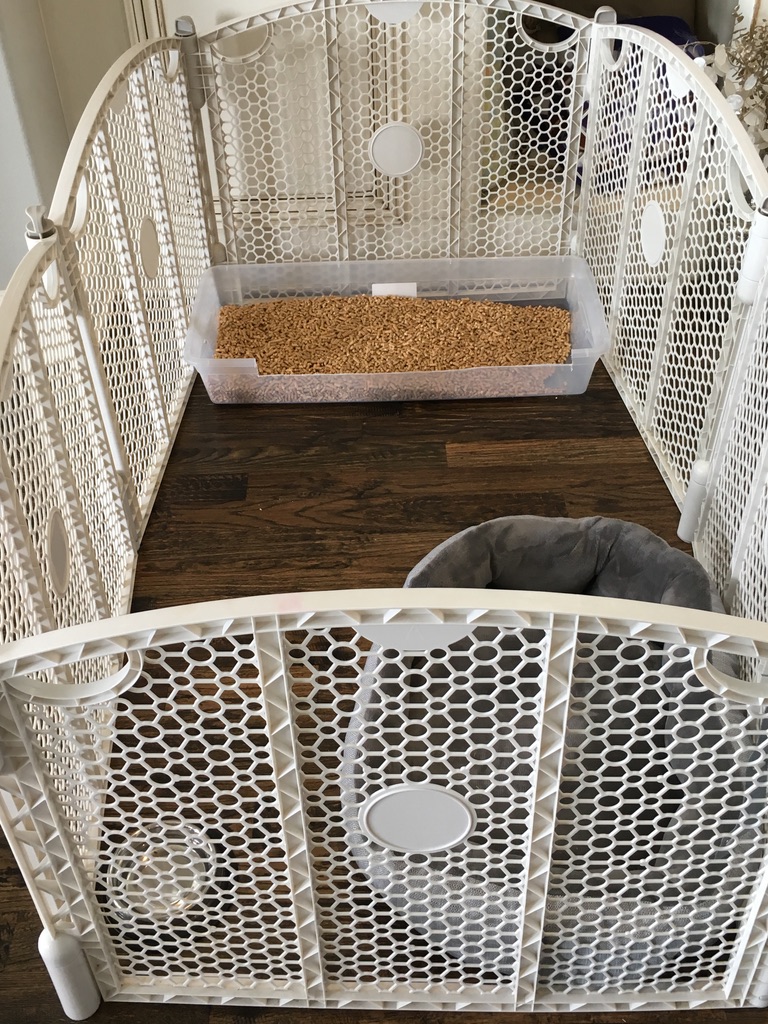
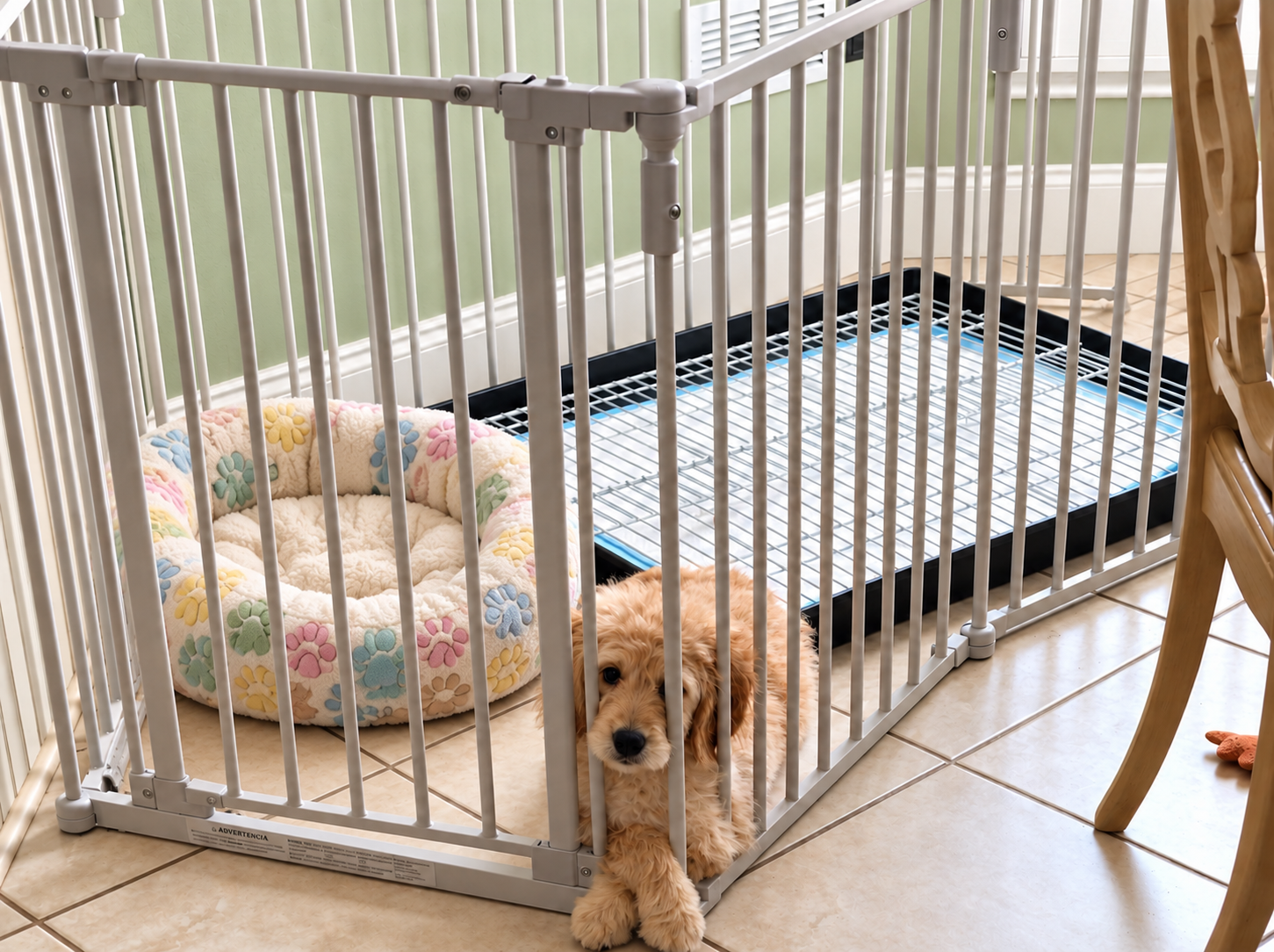
For very young puppies, we recommend a playpen that provides separate areas for sleeping, playing, and going potty. This gives a puppy more space than a crate while still creating a structured environment that supports early potty training.
A playpen setup is ideal for a young puppy. The first picture shows an under-the-bed-storage-container with pine pellets as the potty pan. The second picture shows a potty area using a rabbit hutch pan lined with pee pads, with wire shelving placed over the top to help keep the puppy clean and dry. Both options work very well for young puppies when they must be left alone.
Safari Doodles puppies usually adapt very well to this type of playpen setup. We encourage outdoor potty training as the primary goal! But for overnight use, naps, and times when a very young puppy cannot be supervised, we recommend a playpen like this instead of a crate.
A playpen gives the puppy a comfortable sleeping area along with a separate, designated potty area while they are still learning.
Ready to Find Your Safari Doodles Puppy?
By the time our puppies are ready for their new homes, we have spent weeks getting to know their individual personalities, energy levels, and temperaments. This helps us guide families toward a puppy that may be a good fit for their home and lifestyle.
Ready to get started?